Is Solar Still Worth It in Portland and Vancouver, WA in 2026? The Numbers After the Federal Credit Ended
By Power Professor · 20 min read
For ten years the answer to "is solar worth it in Portland?" started with the same sentence: the federal government pays 30% of it. As of January 1, 2026, that sentence is no longer true for a system you own. The Residential Clean Energy Credit (IRC §25D) was terminated by the July 2025 budget law for any expenditure made after December 31, 2025, and the IRS treats an expenditure as made on the day the installation is completed, not the day you sign or pay a deposit. A homeowner-owned system finished in 2026 gets no federal credit. Not a reduced one. None.
That is the headline, and most solar marketing has not caught up with it. What it does not tell you is that the rest of the picture in Oregon is still reasonably good, that the picture in Clark County is very different, and that the biggest single variable in your payback is not the sun at all. It is the price of electricity you would otherwise buy, and that price is about 19–20 cents in PGE territory and 8.79 cents across the bridge.
We are electricians, not a solar sales company. We do the electrical side of solar: the panel work, the interconnection, the disconnects, the battery gateway, and the utility paperwork, usually alongside a solar installer. So this guide is the version we wish every customer had read before the salesperson showed up: the incentives that actually exist in September 2026, real production data for a Portland roof, an honest payback for each utility, and the part nobody explains until the quote arrives, which is what your electrical service needs to accept the system at all.
What changed in 2026, and what didn't
Three things moved at once. The federal credit ended for homeowner-owned systems. The Oregon Department of Energy's Solar + Storage Rebate ran out of money; it reopened on June 15, 2026 with $1.1 million and was fully reserved almost immediately, so as of this writing it is not taking applications. And Energy Trust of Oregon, the one incentive that is still funded and open, raised its standard solar incentive for PGE customers to a flat $3,500 per home.
On the Washington side nothing changed, which is both the good news and the bad news. Washington has never had a state cash rebate for residential solar; its production-incentive program filled up in 2019 and is winding down. What Clark County homeowners get is the sales-tax exemption and net metering, and both are still in place through 2029.
Residential solar incentives by utility, September 2026
Incentive
PGE (Portland metro)
Pacific Power (Oregon)
Clark Public Utilities (Vancouver / Clark County)
Federal credit (§25D, was 30%)
Ended for installs completed after Dec 31, 2025
Ended
Ended
Energy Trust of Oregon, standard solar
$3,500 per home, min 2 kW, trade-ally installer required
$2,500 per home
Not available (Energy Trust serves Oregon investor-owned utilities only)
Energy Trust Solar Within Reach (income-qualified, from June 1, 2026)
$1.25 per watt, up to $7,500
$0.85 per watt, up to $5,250
Not available
Energy Trust battery incentive (must pair with solar)
$400 per kWh, up to $5,000 ($500/kWh income-qualified)
$288 per kWh, up to $3,600
Not available
Oregon Solar + Storage Rebate (ODOE)
Closed; $1.1M reopened June 15, 2026 and was reserved at once
Closed
Not applicable
State sales tax
Oregon has no sales tax
None
Exempt on systems up to 100 kW AC through Dec 31, 2029 (RCW 82.08.962), roughly 8.5–8.7% saved in Clark County
Property tax
Exempt from the added value (ORS 307.175) through tax years starting before July 1, 2029
Same
No specific exemption found
Net metering credit
Full retail rate, 1:1, monthly rollover
Full retail rate, 1:1
Full retail rate, 1:1
What happens to unused credits
Donated to low-income bill assistance at the end of the March billing cycle
Transferred to low-income program at avoided cost each March
Granted to the utility on March 31, no compensation
Utility application fee
None for systems up to 25 kW
None up to 25 kW
$100 application (under 25 kW) plus $250 + tax meter fee
One trap to watch for: a quote that still shows a line for a 30% federal credit, or an installer who says you can "lock it in" by signing now. Neither is true in 2026. If you see it on a proposal, the rest of the proposal deserves a second look.
How much sun a Portland roof actually gets
Portland averages 68 clear days a year and 223 cloudy ones, and in December the National Weather Service counts two clear days on average. People hear that and assume solar here is a novelty. The production data says otherwise, because what matters is annual energy, not clear days, and Portland's long summer days carry the year.
NREL's PVWatts model, the industry standard for production estimates, puts a south-facing array in Portland at about 1,120 kWh per installed kilowatt per year, which works out to 4.06 peak sun hours a day averaged over the year. Vancouver is essentially the same at 1,110. That is roughly 64% of what an identical array makes in Phoenix and 70% of Denver, and it is more than a typical array produces in Germany, which has more rooftop solar per person than any large country on earth.
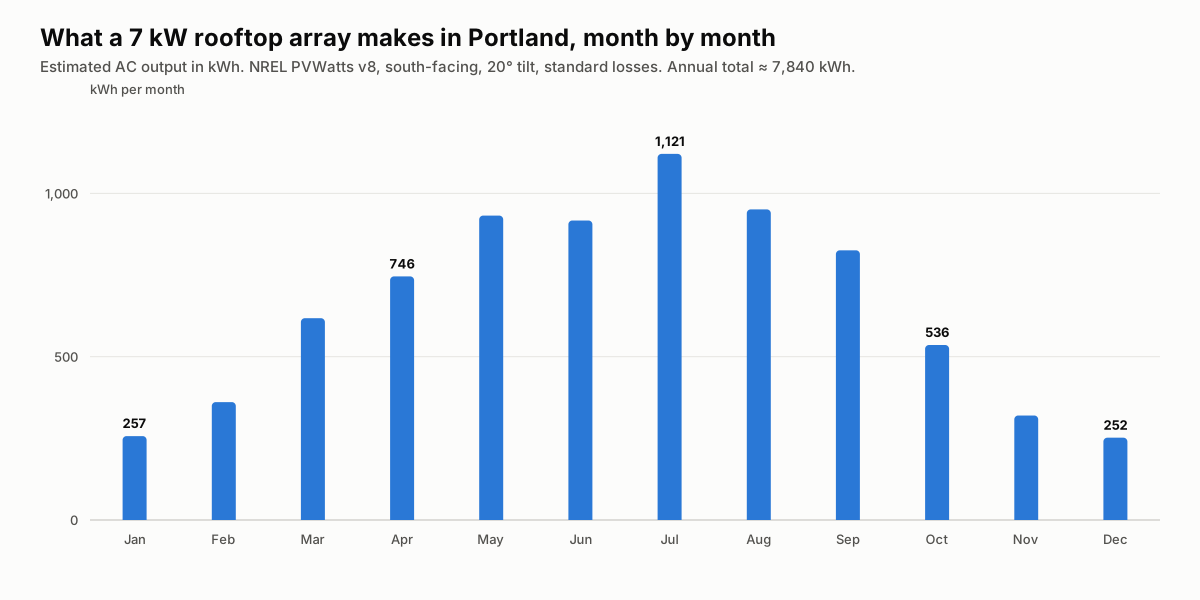
The catch is the shape of the year, not the size of it. A 7 kW array here makes about 1,120 kWh in July and 250 kWh in December, a 4.4-to-1 swing. May through September produce roughly 60% of the annual total. That is exactly why net metering matters more in Portland than in Phoenix: the summer surplus is banked as credits and drawn down in the dark months, and the annual true-up in March is timed so a well-sized system ends the cycle near zero.
Same array, different cities: annual yield per installed kilowatt
Location
kWh per kW per year
Average peak sun hours per day
What that means for a 7 kW array
Phoenix, AZ
1,753
6.5
≈ 12,270 kWh
Denver, CO
1,594
5.7
≈ 11,160 kWh
Portland, OR
1,120
4.1
≈ 7,840 kWh
Vancouver, WA
1,110
4.0
≈ 7,770 kWh
PVWatts v8 estimate for a 7 kW-DC south-facing array at a 20° tilt in Portland: about 7,840 kWh a year, with July producing 4.4 times December. Shade, orientation, and roof pitch move these numbers; a proper quote includes a site-specific estimate.
For scale, the average Oregon household used about 882 kWh a month in 2024 according to the EIA, roughly 10,600 kWh a year. A 7 kW array covers about three quarters of that; a 9–10 kW array covers all of it. Sizing beyond your annual use is money you will not get back, because both states give unused March credits away (Oregon to low-income assistance, Washington to the utility).
The payback math: a PGE home in Portland vs. a Clark PUD home in Vancouver
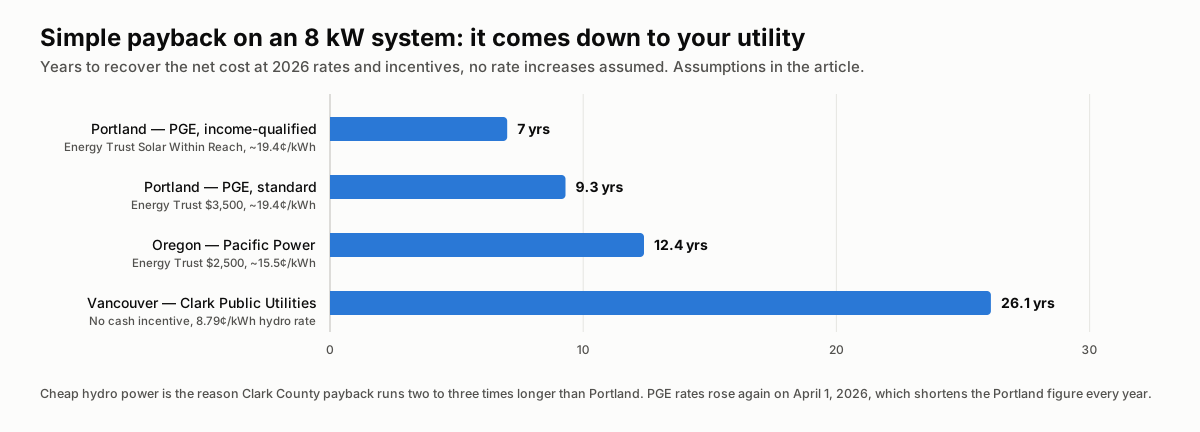
Here is the same 8 kW system priced for both sides of the river, with the incentives that actually exist. We used EnergySage's local marketplace pricing for September 2026 ($2.46 per watt in Portland, $2.55 in Vancouver), PVWatts production, and each utility's current residential rate. This is simple payback: net cost divided by first-year savings, with no rate increases, no financing, and no panel degradation. Real-world payback is a little better than this in Portland because PGE rates keep rising, and a little worse everywhere because panels lose a fraction of a percent a year.
PGE's residential price after the April 1, 2026 increase is roughly 19.4 cents per kWh for the first 1,000 kWh in a month (the exact tariff line depends on your tier). Pacific Power's Oregon rate is 14.5 cents before riders, so call it about 15.5 cents delivered. Clark Public Utilities charges a flat 8.79 cents, unchanged since March 2024, because the county buys hydro power through the Bonneville system.
Simple payback on an 8 kW system, 2026 incentives, no rate escalation
Portland, PGE (standard)
Portland, PGE (Solar Within Reach)
Oregon, Pacific Power
Vancouver, Clark PUD
Installed price before incentives
$19,694
$19,694
$19,694
$20,384 (sales-tax exempt)
Energy Trust incentive
− $3,500
− $7,500
− $2,500
none
Net cost
$16,194
$12,194
$17,194
$20,384
Annual production
8,960 kWh
8,960 kWh
8,960 kWh
8,880 kWh
Electricity price avoided
≈ 19.4¢
≈ 19.4¢
≈ 15.5¢
8.79¢
First-year savings
≈ $1,740
≈ $1,740
≈ $1,390
≈ $780
Simple payback
≈ 9.3 years
≈ 7.0 years
≈ 12.4 years
≈ 26 years
The utility you buy power from matters more than the roof you put panels on. EnergySage's own published estimates land in the same order: 11.7 years for Portland and about 22 for Vancouver.
Read the Portland column and the honest answer is yes, solar still pays in PGE territory in 2026, just not as fast as it did with the federal credit. A 9-year payback on equipment warrantied for 25 is a sound investment, and every PGE rate case shortens it. Households that qualify for Solar Within Reach (in Multnomah, Clackamas and Washington counties the limit is $134,850 for one person and $192,450 for four) are looking at roughly seven years, which is better than most Portland homeowners got in 2024 before the incentive was raised.
Read the Vancouver column and the honest answer is different. At 8.79 cents per kWh, a panel-only system in Clark County is a values purchase or a resilience purchase, not a financial one, and any installer who shows you a 10-year payback there is using a rate that is not yours. Where solar does earn its keep in Clark County is paired with a battery for the outages that have hit the county hard in the last two winters, which we cover in our generator vs. battery backup guide, and for homeowners who plan to add an EV or a heat pump and expect their usage to climb.
Vancouver and Clark County: what still works in your favor
Washington's sales-tax exemption is worth more than it sounds. Clark County's combined state and local rate is in the 8.5–8.7% range, so on a $20,000 system that is roughly $1,700 you simply do not pay, claimed at the point of sale with a buyer's exemption certificate your installer should already have on file. The exemption covers systems up to 100 kW AC and runs through December 31, 2029. Whether it also covers a battery is not spelled out in the statute; get your installer's written position before you count on it.
Net metering with Clark Public Utilities is straightforward: you are credited the full retail rate for every kilowatt-hour your system produces, credits roll month to month, and on March 31 whatever is left goes to the utility with no payment. The application fee is $100 for systems under 25 kW, the bidirectional meter is $250 plus tax, and the utility says applications are typically processed within four working days, with the meter installed within five working days of a passed electrical inspection. There is no Clark PUD rebate for solar, and the modular plug-in "balcony" panels sold online are not legal to connect in Washington.
One more Washington-specific point: the state's net-metering law guarantees the program only until June 30, 2029 or until a utility hits 4% of its 1996 peak load, whichever comes first, and customers who interconnect before then are grandfathered under their agreement. If you are going to do it in Clark County, doing it before 2029 locks in the terms.
Before a module goes on the roof: what your electrical service has to accept
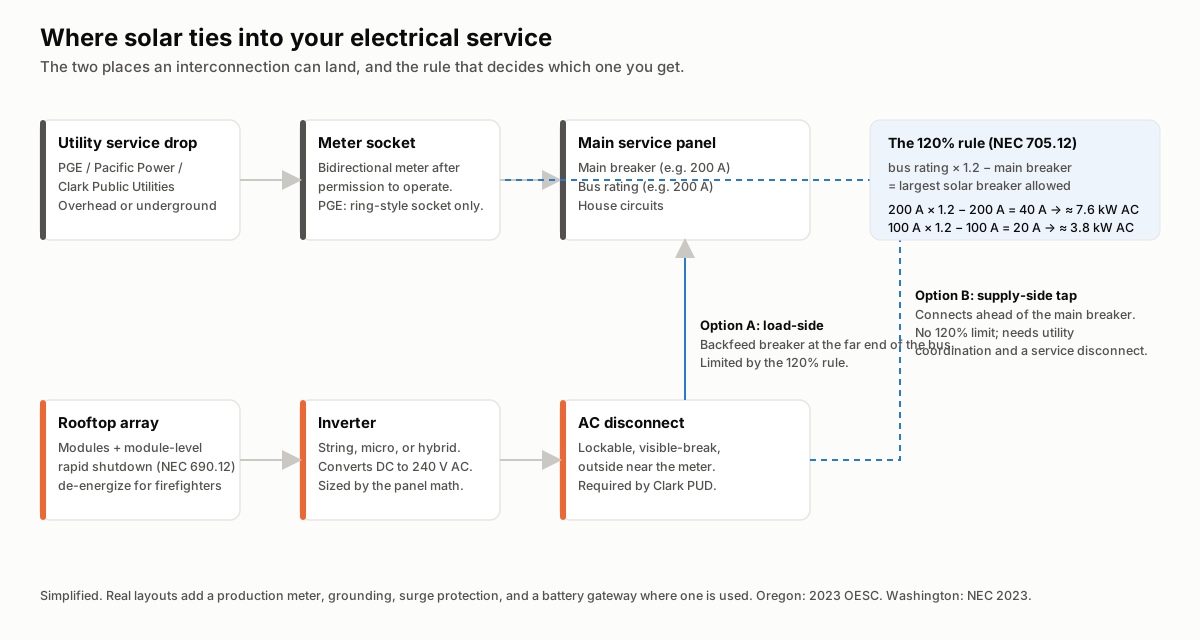
This is the part of a solar quote that is decided by an electrician, and it is where surprises come from. Every solar system has to land in your electrical service somewhere, and the National Electrical Code limits how much you can push back into a panel through a breaker. The rule is called the 120% rule (NEC 705.12), and it is simple arithmetic: multiply the panel's bus rating by 1.2, subtract the main breaker, and what is left is the largest solar breaker you are allowed to install at the far end of that bus.
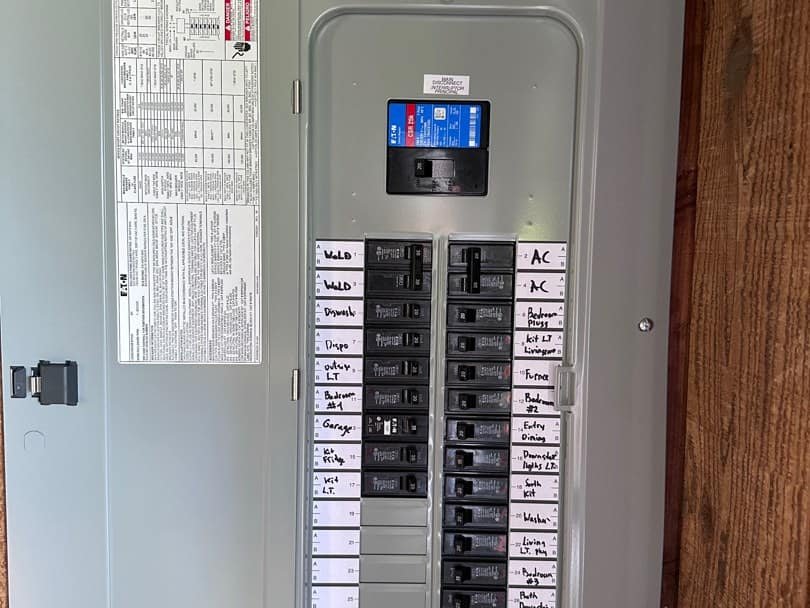
On the most common Portland-area setup, a 200-amp panel with a 200-amp main, that leaves a 40-amp solar breaker. Because breakers are sized at 125% of continuous current, a 40-amp breaker allows an inverter of 32 amps, which is about 7.6 kW of AC output, or a DC array of roughly 9 kW. Most single-family systems fit under that. On a 100-amp panel, which is what a lot of pre-1980 homes in Portland, Gresham and Vancouver still have, the math gives you 20 amps and an inverter of about 3.8 kW, which is too small for most households.
How much solar a panel can take through a backfeed breaker (NEC 705.12 load-side rule)
Panel bus
Main breaker
Largest solar breaker
Max inverter output
Approximate DC array size
100 A
100 A
20 A
≈ 3.8 kW AC
≈ 4.5 kW
125 A
100 A
50 A
≈ 9.6 kW AC
≈ 11.5 kW
200 A
200 A
40 A
≈ 7.6 kW AC
≈ 9 kW
200 A
175 A (main derated)
65 A
≈ 12.5 kW AC
≈ 15 kW
225 A
200 A
70 A
≈ 13.4 kW AC
≈ 16 kW
The two ways solar lands in your service. Most homes use the load-side breaker; larger arrays or full panels use a supply-side tap or a service upgrade.
When the array you want does not fit, there are three ways out, in rising order of cost. A main breaker derate swaps the 200-amp main for a 175-amp one, which frees up 25 amps of solar capacity; it only works if a load calculation shows the house never needs the full 200 amps, which a house with an EV charger and a heat pump often does. A supply-side tap connects the solar ahead of the main breaker, between the meter and the panel, which sidesteps the 120% rule entirely but requires its own fused disconnect, a meter-side connection, and coordination with the utility; PGE in particular has firm rules about the meter socket. Or a panel or service upgrade, which is the right answer when the panel is old, full, or a Federal Pacific or Zinsco unit that should be replaced anyway. We publish real numbers for that in our panel upgrade cost guide, and it is the reason a solar quote should always include a photo of your panel before it includes a price.
The other electrical requirements that show up on the inspection
Rapid shutdown (NEC 690.12). Every rooftop system needs module-level electronics that drop the array's conductors to a safe voltage within seconds when the system is shut off, so firefighters can work on the roof. Microinverters and DC optimizers do this by design; a plain string inverter needs add-on shutdown devices.
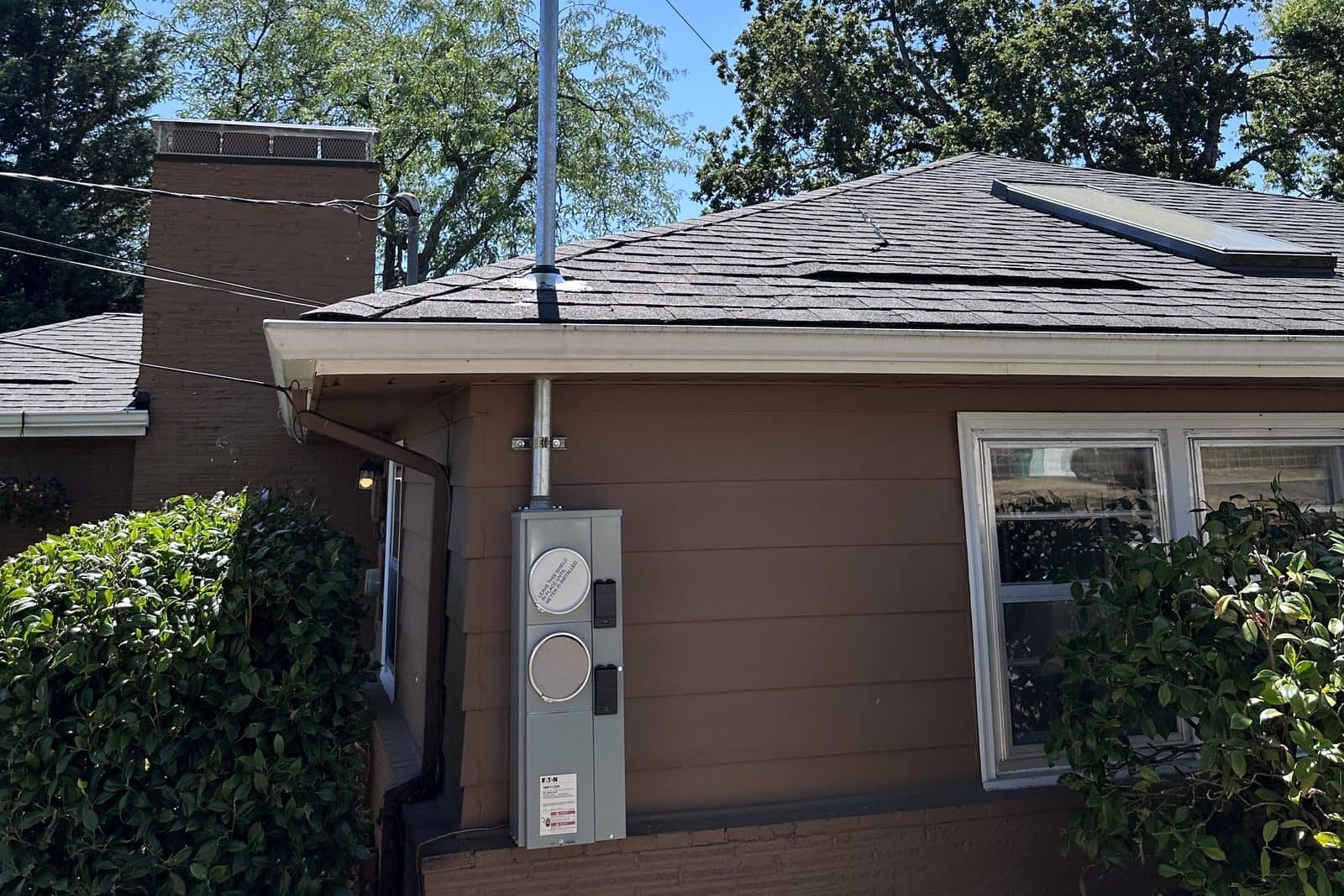
AC disconnect. A lockable, visible-break disconnect outside near the meter. Clark Public Utilities requires one that its crews can reach and lock; PGE's requirements depend on the meter arrangement. It is cheap, and inspectors look for it first.
Meter socket. PGE's 2026 service requirements allow only ring-style meter sockets and require notification before load or generation is added. An old socket can turn a solar job into a small service upgrade.
Grounding and bonding. The array frame, racking and inverter all bond back to the service's grounding electrode system. Homes with an incomplete or corroded ground rod get that corrected as part of the job.
Panel labeling. The code requires a specific set of placards at the service, the disconnect and the panel so that anyone opening it knows there is a second source of power. Missing labels are one of the most common reasons a solar inspection fails the first time.
Battery-ready wiring. If a battery is even a possibility, the interconnection should be built around a gateway or a backup-capable panel now. Adding a battery to a system that was not wired for one usually means redoing the interconnection.
None of this is exotic. It is the ordinary work of a licensed electrical contractor, and on a well-run solar job it is invisible. It becomes visible when a solar company subcontracts the electrical to whoever is cheapest that week. Ask who is pulling the electrical permit and who will be on site for the inspection; if the answer is vague, that is your answer.
Permits, inspections and interconnection: Portland vs. Vancouver vs. Clark County
Oregon permits residential rooftop solar under the Oregon Residential Specialty Code (section R324) with a prescriptive checklist: if the array weighs 4.5 pounds per square foot or less, sits no more than 18 inches above the roof surface, and the roof is conventional light framing with rafters on 24-inch centers or closer, no engineer is needed. Heavier systems, tile roofs, or older or unusual framing go the engineered route. Washington runs a similar split, with engineering required in Vancouver when the dead load exceeds 4 pounds per square foot.
Who permits what, 2026 fee schedules
City of Portland
City of Vancouver, WA
Unincorporated Clark County
Structural / building permit
Portland Permitting & Development, prescriptive path, published estimate about $576
City building permit, valuation-based fee
Clark County building permit
Electrical permit
PP&D renewable-energy fee: $187 up to 5 kVA, $283 for 5.01–15 kVA, plus 12% state surcharge (July 10, 2026 schedule)
City-issued electrical permit (Vancouver runs its own electrical program)
Washington L&I electrical permit, typically the altered service/feeder line, about $110 (July 2026 schedule)
Who inspects
City of Portland electrical inspector
City of Vancouver electrical inspector
L&I Vancouver field office
Utility application
PGE: free for systems up to 25 kW, acknowledged within 3 business days, approved within 10 business days of a complete application
Clark PUD: $100 application, $250 + tax meter, processed within about 4 working days
Same as Vancouver
Meter and permission to operate
PGE installs a bidirectional meter after the passed inspection and signed agreement
Meter typically installed within 5 working days of the passed inspection
Same
Typical timeline, permit to power-on
4–8 weeks; longer in summer when PP&D review backs up
3–6 weeks
3–6 weeks
On the Oregon side the state also takes 12% of every permit fee as a surcharge, which the fee estimates on the City's website do not always show. Budget for it. And on both sides, the single biggest cause of delay is an incomplete application: a missing single-line diagram, an unlisted inverter, or a panel photo that shows a problem nobody priced. A contractor who has done this before submits a package the reviewer can approve without a phone call.
Is a battery still worth adding?
The federal credit on batteries ended on the same day as the credit on panels, and the Oregon storage rebate is closed with the rest of the ODOE program. What remains is meaningful in PGE territory and thin elsewhere. Energy Trust pays $400 per kWh up to $5,000 for a battery installed with a qualifying solar system in PGE territory ($500 per kWh up to $6,250 for income-qualified households), and $288 per kWh up to $3,600 in Pacific Power territory. On a 13.5 kWh unit that is $5,000 in Portland, roughly a third of the installed price.
On top of that, PGE's Smart Battery Pilot pays $1.70 per kWh your battery delivers during grid events, typically 10 to 15 a year, and Pacific Power's Wattsmart Battery program pays $600 per kW up front, capped at $3,000, plus a small annual credit. Clark Public Utilities has no battery incentive.
Whether a battery pays for itself on bill savings alone is a different question, and in Oregon, with 1:1 net metering, the honest answer is usually no; the grid is already your free battery. What a battery buys is backup power through the ice storms and windstorms that have taken out hundreds of thousands of metro customers in each of the last three winters. We wired a whole-home EcoFlow battery system with a Tesla charger in Vancouver for exactly that reason, and we compare batteries against generators, with runtime math, in the backup power guide.
Leases and power-purchase agreements: the credit didn't end for everyone
Here is a wrinkle most homeowners will not hear about. The credit that ended in 2025 was the homeowner's credit. The business credit for solar (IRC §48E) is still alive for systems owned by a third party, which is exactly how a lease or a power-purchase agreement works: the solar company owns the array on your roof, claims the credit, and prices your monthly payment accordingly. Under IRS Notice 2025-42 those systems have to be placed in service by December 31, 2027 (or have begun construction by July 4, 2026), so a lease signed in late 2026 still fits inside the window.
That makes a 2026 lease cheaper relative to buying than it was in 2025, and some installers will lead with it. Go in with your eyes open. You do not own the system, the payment usually escalates 2–3% a year, the contract runs 20–25 years and has to be transferred when you sell the house, and the production guarantee is only as good as the company behind it. A lease can still be the right call for a household that cannot use the Energy Trust incentive or does not want the capital outlay; it is rarely the cheapest path over 25 years for one that can buy outright.
Seven questions to ask any solar quote in Portland or Vancouver
Where did the production estimate come from? It should be a PVWatts or equivalent model run for your roof's actual orientation, tilt and shading, not a per-watt rule of thumb. Ask for the annual kWh and the monthly curve.
Is the installer an Energy Trust trade ally? In PGE and Pacific Power territory the $3,500 or $2,500 incentive only exists if the installer is enrolled. If they are not, that money is gone.
How is the system connecting to my service? Load-side breaker, supply-side tap, or a service upgrade. If the answer requires a panel change, is it in the price, and who is doing it?
Is it sized to my annual use, not above it? Anything beyond roughly 100% of your yearly kWh is credit you will give away in March.
Which inverter, and how does rapid shutdown work? You want a named product with a UL 1741 listing and module-level shutdown, not "we'll figure it out at install."
Who pulls the permits and attends the inspection? Both the structural permit and the electrical permit, in your jurisdiction, under a license you can look up.
Does the quote mention the 30% federal credit? If it does, the numbers are from 2025 and so, possibly, is everything else in it.
Where Power Professor fits
We are the licensed electrical contractor on the solar job, not the company selling you panels, and we are fine with that. Our crews have handled the electrical on Tesla solar installations in Beaverton and Gresham, replaced failed inverters on systems from Longview up to Chehalis, and taken down and reinstalled a Tigard array so a roof could be replaced underneath it. The solar electrical work we do is the interconnection, the disconnects, the rapid-shutdown wiring, the battery gateway, and the panel or service upgrade that has to happen first, along with the permit and the inspection.
If you are shopping for solar in Portland or Vancouver and want a straight answer on whether your panel can take it before you sign, send us a photo of the panel and the meter. That is usually enough to tell you whether you are looking at a 40-amp breaker or a service upgrade, and we will put it in writing. And if you are already looking past solar to an EV charger or a battery, it is worth planning the panel for all of it at once.
Answers
Frequently asked questions
01Is solar worth it in Portland, Oregon in 2026?
In PGE territory, yes, with a longer payback than before. Without the federal credit, an 8 kW system nets about $16,200 after Energy Trust's $3,500 incentive and saves roughly $1,700 a year at PGE's 19–20 cent rate, a simple payback of about 9 years on equipment warrantied for 25. Income-qualified households using Solar Within Reach are closer to 7 years. Every PGE rate increase shortens it.
02Is the 30% federal solar tax credit still available in Oregon or Washington?
No. The Residential Clean Energy Credit (§25D) ended for any expenditure made after December 31, 2025, and the IRS counts an expenditure as made when installation is completed. A homeowner-owned system finished in 2026 gets no federal credit regardless of when the contract was signed. Third-party-owned systems (leases and PPAs) can still use the separate business credit through 2027.
03How much does a solar system cost in Portland in 2026?
EnergySage marketplace pricing for Portland in mid-2026 is about $2.46 per watt: roughly $14,800 for 6 kW, $19,700 for 8 kW, and $24,600 for 10 kW before incentives. Full-service installers with in-house crews typically quote around $3.00 per watt. Add a panel or service upgrade if your existing service cannot accept the array.
04Is solar worth it in Vancouver, WA with Clark Public Utilities?
Financially it is marginal. Clark PUD's rate is 8.79 cents per kWh, less than half of PGE's, and there is no state or utility cash rebate, so an 8 kW system's simple payback runs 22–26 years. The sales-tax exemption saves roughly 8.5% and net metering is 1:1, but most Clark County homeowners who install solar do it for backup power with a battery, for expected higher future usage, or for reasons other than payback.
05What does Clark PUD do with extra solar credits?
Credits roll over month to month at the full retail rate, and on March 31 each year any unused credits are granted to the utility with no compensation, as Washington's net-metering law requires. Size the system to your annual use, not above it.
06Do I need a 200-amp panel for solar?
Not always, but the 120% rule limits how much you can backfeed. A 200-amp panel with a 200-amp main allows a 40-amp solar breaker, or about 7.6 kW of inverter output, which fits most homes. A 100-amp panel allows only 20 amps, about 3.8 kW, which is too small for most households, so 100-amp homes usually need a main-breaker derate, a supply-side tap, or a service upgrade.
07Does solar work in Portland's rain and clouds?
Yes. Production depends on annual energy, not clear days. PVWatts estimates about 1,120 kWh per installed kilowatt per year in Portland, roughly 64% of Phoenix and more than most of Germany. Summer months produce about 60% of the annual total, and net metering banks that surplus for winter.
08How long does solar permitting and interconnection take in Portland?
Typically four to eight weeks from a complete permit application to permission to operate. Portland Permitting & Development reviews the prescriptive application, the City inspects the electrical, and PGE approves complete interconnection applications within 10 business days and installs a bidirectional meter after the inspection passes. Summer backlogs and incomplete applications are the usual causes of delay.
A 100 amp service is still legal, still sellable and still enough for plenty of gas-heated homes. It stops being enough when a heat pump, EV charger or electric range arrives. Here is how to tell which side of that line your house is on, with a worked load calculation.
A subpanel adds circuits where you need them without touching the service. The mistakes happen in the details: wire that is really rated 90 amps, neutrals bonded to ground, and detached buildings with no ground rods. Here is how it is done properly.
Every panel or service upgrade in Oregon needs an electrical permit and an inspection before the utility will reconnect. In Portland the permit fee is $212 for a service up to 200 amps, plus the 12% state surcharge. Here is who issues it, how to apply, and what happens on inspection day.
Find out what your panel can take before you sign for solar.
Send us a photo of your electrical panel and meter. We'll tell you whether your service can accept the array, what the interconnection will need, and what a panel upgrade would cost if it comes to that. Portland, Vancouver, and the metro in between.