Electrical Permits for a Panel Upgrade in Portland and Oregon (2026 Guide)
By Power Professor · 12 min read
Short answer: yes, every electrical panel or service upgrade in Oregon needs an electrical permit and a passed inspection. In the City of Portland the permit for a service of 200 amps or less is $212, and the State of Oregon adds a 12% surcharge, so about $237 before anything else. A 201 to 400 amp service is $298 plus the surcharge. The permit is normally pulled online through Portland's DevHub by the licensed electrical contractor doing the work, and it is usually issued within a day of payment.
Two things catch homeowners out. First, the permit office depends on the address, not the mailing city: Portland, Gresham, Washington County and Clackamas County each run their own electrical program, with different fees and different inspectors. Second, the inspection is not a formality. PGE will not reconnect a new meter base until the inspector's approval sticker is on it, and the city does not call PGE for you.
This guide walks through who issues the permit where you live, what it costs as of the fee schedules that took effect in July 2026, how the online application works, which inspections a service change needs, and how the utility reconnect fits in. It is written for the Oregon side of the metro; if you are in Vancouver or Clark County, the Washington section near the end covers you.
Do you need a permit to upgrade your panel?
Yes. Oregon law requires an electrical permit for new electrical installations and substantial alterations, and replacing a panel, a meter base or a service is both. There is no size threshold and no exception for a like-for-like swap. The same is true when the panel stays the same size and only the breakers change brands, when a fuse box is converted to breakers, and when a subpanel is added.
Oregon's short list of permit-free electrical work is narrow on purpose. Under OAR 918-309-0000 no permit is needed to replace light bulbs, fluorescent tubes or approved fuses, to plug portable equipment into existing receptacles, or to swap an existing garbage disposal, dishwasher, electric water heater or similar appliance of 30 amps or less. A panel is nowhere near that list.
It is also not something the state's cheaper minor label program can cover. Minor labels are $14 inspection labels that licensed contractors can use for small jobs, such as a single new circuit of limited size or a 40 amp EV charger circuit in a garage. The rule behind them says it directly: the complete replacement of a service is not allowed on a minor label, and the Building Codes Division's scope sheet adds panel replacement to the excluded list.
Who issues the permit: it depends on the address
Oregon lets cities and counties run their own electrical programs. In the Portland metro almost every jurisdiction does, so the first step is working out which counter your address belongs to. The mailing city on your envelope is not a reliable guide, especially near city limits.
Inside City of Portland limits, Portland Permitting & Development (PP&D, formerly the Bureau of Development Services) issues electrical permits and does the inspections. Multnomah County has intergovernmental agreements with Portland, Gresham and Troutdale to administer building codes in unincorporated areas, so parts of unincorporated Multnomah County are served by Portland under a separate but identical fee schedule, and other parts by Gresham or Troutdale.
Who issues residential electrical permits in the Oregon side of the metro
Where the property is
Who issues the electrical permit
How to apply
City of Portland
Portland Permitting & Development
Online through DevHub, or the Electrical Permit Application by email
Unincorporated Multnomah County (Portland service area)
Portland Permitting & Development, under a county agreement
Same as Portland; separate county fee schedule with the same amounts
Gresham and parts of east Multnomah County
City of Gresham
Gresham's own electrical permit application
Troutdale
City of Troutdale
Troutdale's own electrical permit application
Unincorporated Washington County
Washington County Building Services
County application; cities such as Beaverton and Hillsboro run their own
Clackamas County and its contract cities
Clackamas County Building Codes
County online permitting; some cities run their own
Jurisdictions without their own program
Oregon Building Codes Division
Oregon ePermitting at buildingpermits.oregon.gov
If you are not sure which one applies, the county assessor's record for your property shows whether it is inside city limits, and the Building Codes Division keeps a directory of local building departments. Or send us the address: working this out is part of every quote we write.
What the permit costs in 2026
Portland's electrical fees changed on July 10, 2026, after City Council approved an increase in June. Some older guides, including an earlier version of ours, quoted $239 for a 200 amp service. That figure is actually the Portland fee for a manufactured or modular home. The service line on the current application reads $212 for 200 amps or less.
On top of every building, plumbing, electrical and mechanical permit, the State of Oregon collects a 12% surcharge. When plan review is required, which it rarely is for a single-family service change, it adds another 25% of the permit fee.
Residential electrical permit fees for a service change, effective July 2026
Jurisdiction
Service up to 200A
201 to 400A
Notes
City of Portland
$212
$298
Plus 12% state surcharge: about $237 and $334
Unincorporated Multnomah County (Portland area)
$212
$298
Separate county schedule, same amounts; plus 12%
Unincorporated Washington County
$236
$353
FY 2026-27 application; plus 12%
Extra branch circuits on the same permit
$21 each
$21 each
Portland: added to a service permit
Those are government fees only. What you see on a contractor's quote for "permit and inspection" also covers pulling the permit, the inspection visit, coordinating the utility and any return trip. We bill $350 to $750 for that line depending on the jurisdiction and scope, and the city's fee is inside it rather than added on later. For the full cost of the job itself, see our panel upgrade cost guide.
How to apply in Portland: DevHub, the PDF form, and who signs
Portland's fastest route is DevHub, the city's online permit portal. Standard electrical trade permits that do not need plans, which covers a normal residential service change, are applied for and paid for online, and the city says permits are issued within 24 hours after payment.
If you would rather not use DevHub, the city still publishes a PDF Electrical Permit Application. It is used for jobs that need plans, for emailed applications to the trade permit team, and for in-person appointments. It is the same form that lists every fee on one page, which makes it a handy reference even if you apply online.
Who signs matters. Portland will not approve or issue an electrical permit for construction until an electrical contractor is on record, and the contractor has to list both an Oregon CCB license and a Building Codes Division electrical license. The one exception is a homeowner doing work on a home they own and live in, which has its own rules. We cover that separately in can a homeowner do their own electrical work in Oregon.
Confirm the jurisdiction and the service size you are installing (200A or 400A).
The licensed contractor creates the trade permit in DevHub and lists the service change plus any new circuits.
Pay the permit fee and the 12% state surcharge; the permit is typically issued within a day.
Notify the utility and schedule the disconnect for the day of the work.
Do the work, then request the service inspection.
Once the service passes, the utility reconnects; the permit closes after the final inspection.
What gets inspected on a service change
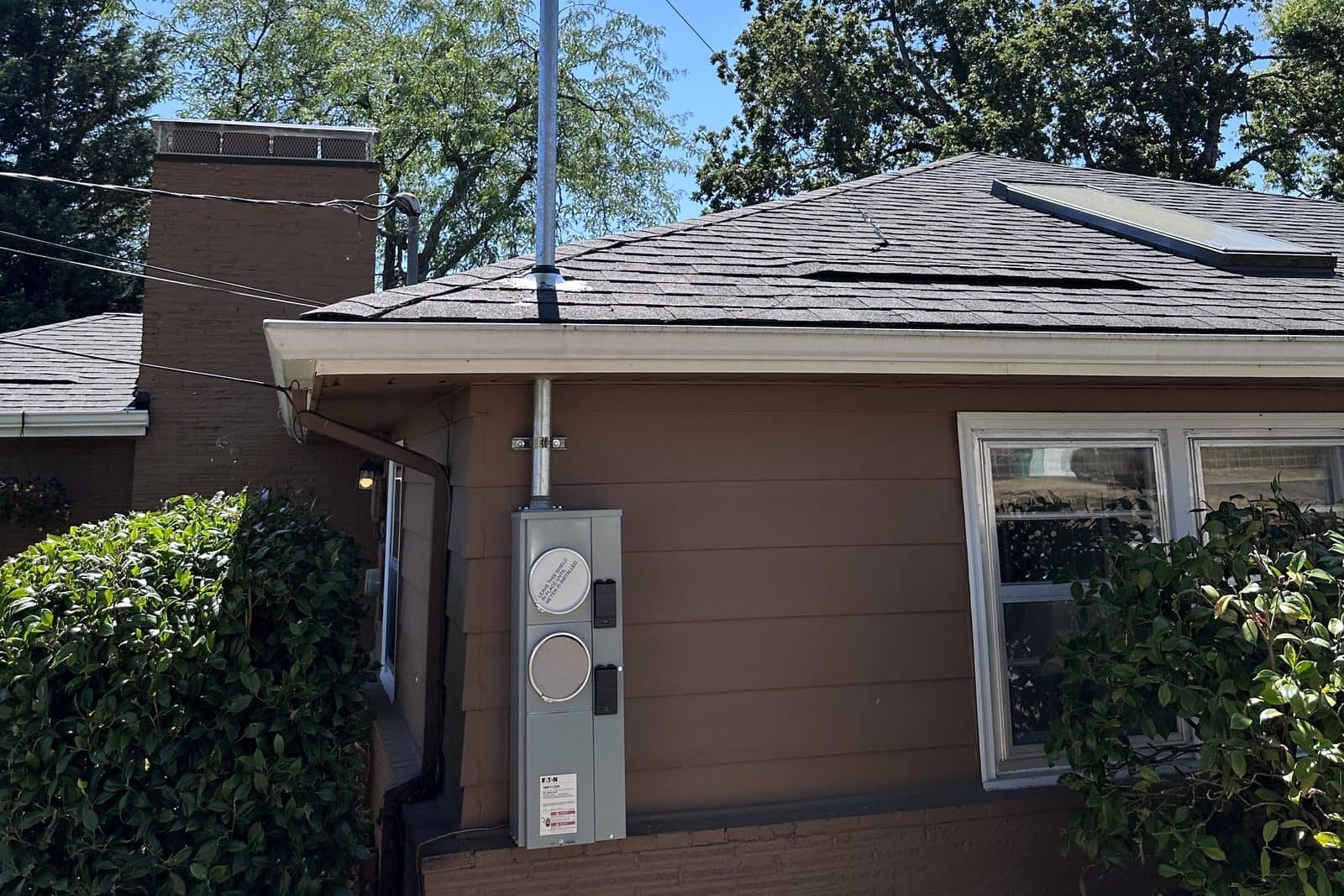
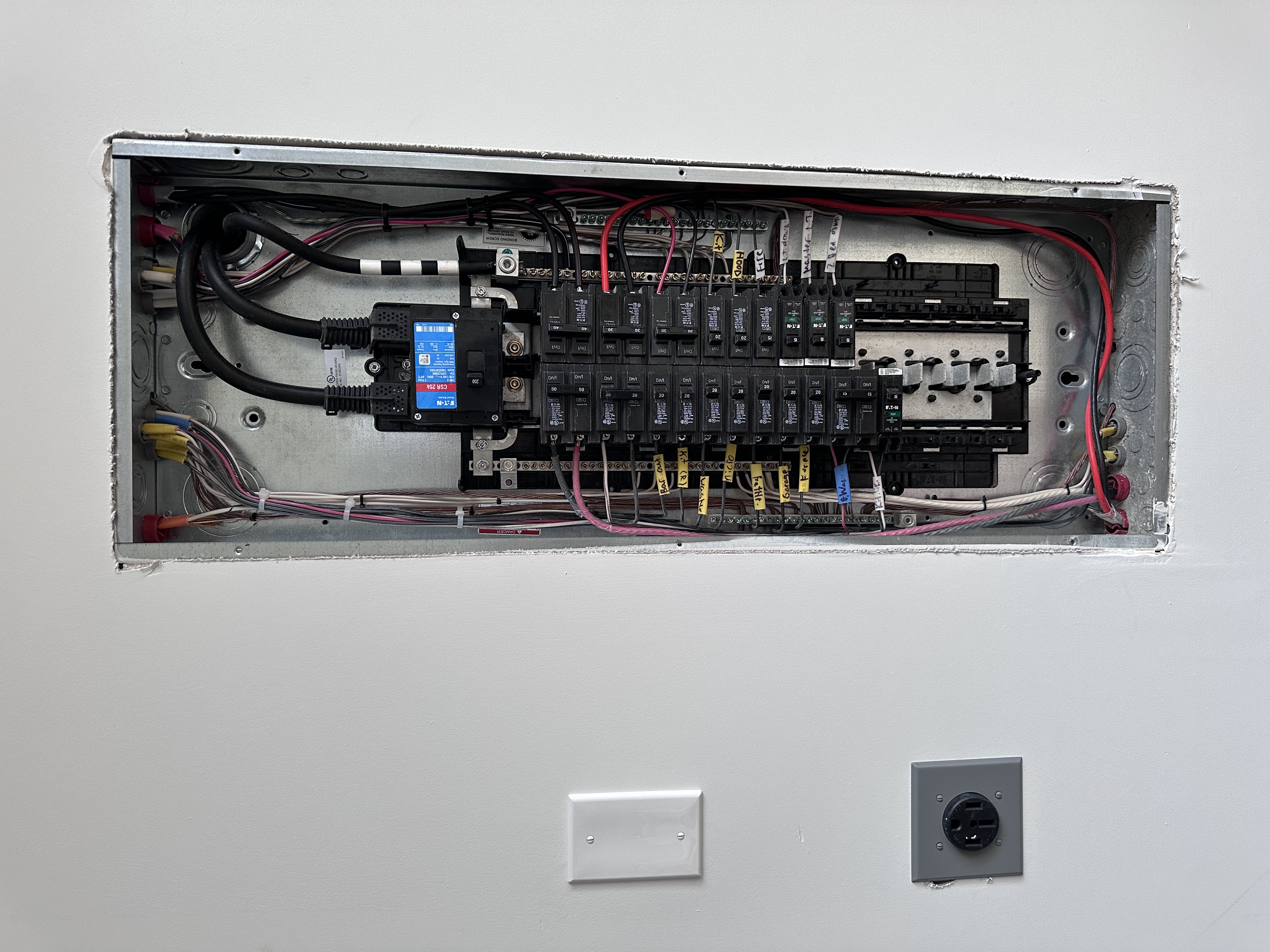
A panel or service upgrade gets a service inspection. The inspector checks the meter base, the service entrance conductors and mast or underground conduit, the grounding electrode system and bonding, the panel itself, working clearances, and that the new breakers are the right type and rating for the panel. If walls were opened for new circuits, there may also be a rough-in inspection before they are closed.
Every Portland electrical permit also needs the 199 Final Electrical Permit inspection before the city closes it. Portland schedules inspections in DevHub or through its automated phone line at 503-823-7000 using the permit number and a three-digit inspection code.
Portland inspection codes used on a residential service change
Code
Inspection
When it is used
120
Permanent electrical service
New or replaced service, meter base or panel
145
Circuits and feeders
Added subpanel or new feeders and circuits
105
Rough-in
New wiring in walls before they are covered
199
Final electrical
Required on every permit before it closes
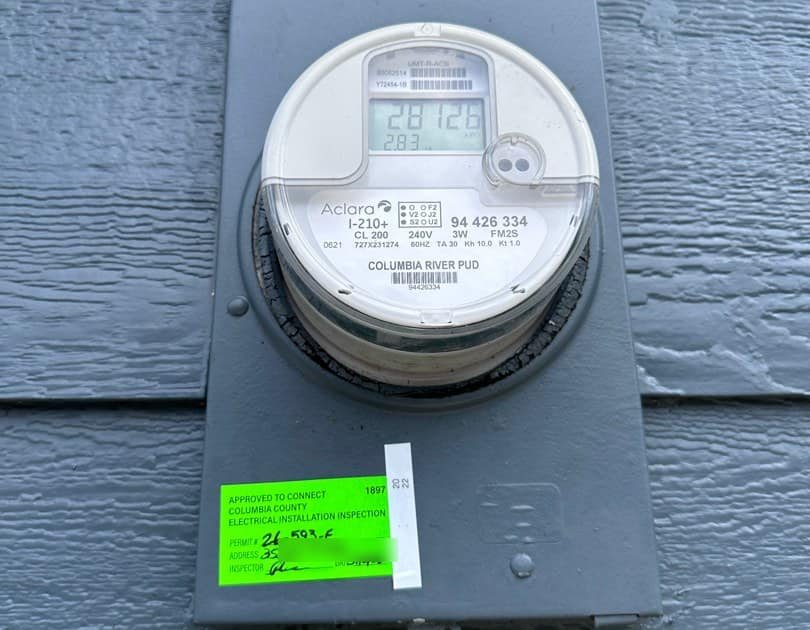
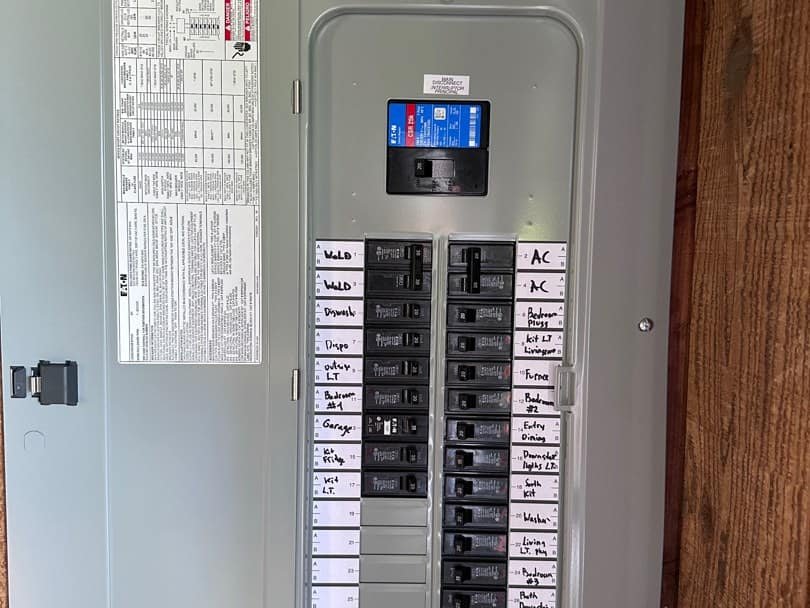
The approval sticker the inspector leaves on the meter base after a service change on one of our jobs. The utility looks for it before reconnecting.
Getting the power back on: PGE and Pacific Power
This is where most delays come from. PGE's own checklist for remodels says the meter base must carry the city or county approval sticker before PGE will connect, and that the city or county does not notify PGE. Somebody has to call. On our jobs that is us, and we book it before the work starts so the crew and the utility show up on the same day.
PGE's Electric Service Requirements also ask for written notice before a customer adds load or modifies existing electrical equipment, which a service upgrade does. If the upgrade changes the service size, the utility may also want to check that its transformer and drop are adequate.
For an existing home where power was interrupted by the service change, Oregon allows a licensed supervising electrician to give the utility a written request to re-energize before the inspection, as long as the inspecting authority is notified within one business day and the inspection is requested. That rule, OAR 918-311-0070, is what makes a same-day panel swap possible. It is limited to licensed contractors, so a homeowner doing their own service change should expect to wait for the inspection before the lights come back on.
Oregon's electrical code changes on October 1, 2026
Oregon adopts the National Electrical Code with state amendments as the Oregon Electrical Specialty Code. The 2026 OESC, based on the 2026 NEC, takes effect on October 1, 2026, replacing the 2023 edition. If your permit straddles the change, ask the permit office which edition applies.
For a typical single-family panel upgrade the practical changes are small, and your electrician deals with them. One worth knowing about: in the 2026 NEC the load calculation rules moved from Article 220 to a new Article 120, so a load calculation printout may cite different section numbers than an older one. Washington stays on the 2023 NEC until December 31, 2026.
How long the permit process takes
The permit itself is quick in Portland: typically issued within a day of payment for a trade permit with no plans. What takes time is scheduling around the utility and the inspector. On most of our residential jobs the calendar looks like this.
Permit issued: same day to one business day after we apply.
Utility coordination: a few days to a couple of weeks, depending on whether the utility needs to change the drop or the transformer.
The work: one day for a standard panel or 100A-to-200A upgrade; longer if the mast, grounding or panel location change.
Inspection: usually within a few business days of the request.
Final and closeout: the permit shows as finaled in DevHub once the 199 final passes.
If you are in Vancouver or Clark County
Washington handles this differently. Inside Vancouver city limits, the City of Vancouver issues electrical permits and does its own inspections. The rest of Clark County, including Camas, Washougal, Battle Ground and Ridgefield, is inspected by the state Department of Labor & Industries (L&I).
L&I's fees changed on July 1, 2026. An altered service or feeder on an existing home is $109.90 for 0 to 200 amps and $161.00 for 201 to 600 amps. The City of Vancouver's 2026 fee sheet lists a residential electrical service of 0 to 200 amps with feeder at $88.20. Washington also requires that the permit be bought by whoever is doing the work, and L&I can fine up to $2,000 for starting electrical work without one.
On the Washington side, Clark Public Utilities is the utility, and only their crew removes a meter. For the full comparison, including utility steps on both sides of the river, see our panel upgrade cost guide.
01Do you need a permit to upgrade to 200 amp service in Oregon?
Yes. A service or panel upgrade is a new installation under Oregon law and needs an electrical permit and a passed inspection. It cannot be done on a minor label, and the utility will not reconnect without the inspector's approval on the meter base.
02How much is a panel upgrade permit in Portland?
As of the fee schedule effective July 10, 2026, Portland charges $212 for a service of 200 amps or less and $298 for 201 to 400 amps, plus Oregon's 12% state surcharge. That is about $237 for a typical 200 amp upgrade. Added circuits on the same permit are $21 each.
03Can I apply for a Portland electrical permit online?
Yes. Portland's DevHub portal handles electrical trade permits that do not need plans, and the city says they are issued within 24 hours after payment. A PDF Electrical Permit Application is also available for emailed or in-person applications.
04Who does electrical inspections in unincorporated Multnomah County?
Multnomah County has agreements with Portland, Gresham and Troutdale. Portland Permitting & Development covers the Portland service area under a county fee schedule with the same amounts as the city, while Gresham and Troutdale serve other parts of east county. Check your address before applying.
05Does the city tell PGE when my inspection passes?
No. PGE says the city or county does not notify it. PGE looks for the approval sticker on the meter base and connects after the customer or contractor contacts them. A licensed supervising electrician can also request an early reconnect before inspection under OAR 918-311-0070.
06Is there a PDF permit application for Oregon panel upgrades?
Each jurisdiction has its own. Portland's is the Electrical Permit Application, revised July 10, 2026. Washington County, Gresham and Troutdale publish their own forms, and jurisdictions without a local program use the state's Oregon ePermitting system.
07How long does a panel upgrade permit take?
In Portland, a trade permit with no plans is usually issued within a day of payment. The longer waits are utility coordination and the inspection visit, which together usually add a few days to two weeks.
08What happens if my panel was replaced without a permit?
It usually surfaces at a sale, an insurance claim or the next time the utility has to touch the meter. The fix is a retroactive permit and inspection, which can mean opening covers or walls so the inspector can verify the work. Call the permit office or an electrician before you list the house.
Electrical panel upgrades and replacements for Portland and Vancouver, WA homes — 100A to 200A service upgrades, Federal Pacific and Zinsco swaps, permit and inspection included, priced in writing before we start.
Full-service residential electrical work for Portland and Vancouver homeowners — panel upgrades, rewiring, lighting, and everyday repairs done safely and to code.
A no-charge visual check of your home's electrical system — panel, grounding, outlets, GFCI and AFCI protection, smoke alarms and visible wiring. Roughly 45 minutes, written findings, no obligation.
A 100 amp service is still legal, still sellable and still enough for plenty of gas-heated homes. It stops being enough when a heat pump, EV charger or electric range arrives. Here is how to tell which side of that line your house is on, with a worked load calculation.
A subpanel adds circuits where you need them without touching the service. The mistakes happen in the details: wire that is really rated 90 amps, neutrals bonded to ground, and detached buildings with no ground rods. Here is how it is done properly.
Oregon lets owners wire their own home without a license, but not without a permit, and not on a house that is for sale or rent. Portland adds its own conditions. Here is what the law allows on both sides of the Columbia, what is permit-free, and where DIY stops making sense.